
Do tree stumps attract termites? A rotting stump can certainly feed them. NC State Extension describes eastern subterranean termites, the common species in North Carolina, as feeding on "almost anything that contains cellulose," and a decaying stump is exactly that. But the same NC State publication makes a point many homeowners miss: "Swarmers found outdoors near tree stumps, landscape timbers, etc., are not an indication that your house is infested."
So a stump with termites in it is a sign termites live in your yard, which in much of North Carolina is normal. It is not, on its own, a sign they are in your house.
Stump Grinding Durham is a free quote service, not a tree company. We connect Durham-area homeowners with independent local stump grinding and tree companies for free, no-obligation quotes; the company you choose quotes, schedules and does the work directly with you.
What NC State Extension says
NC State's publication Monitoring and Management of Eastern Subterranean Termites is the source to read. The key points for stump owners:
- Termites eat cellulose. Stumps, roots, logs, landscape timbers and wood mulch are all potential food.
- Outdoor swarmers aren't proof of an indoor problem. Seeing a swarm near a stump in spring does not mean the house is infested.
- Wood-to-ground contact at the house is the conducive condition. Siding, trim, posts or framing that touch the soil give termites a direct route in.
You may see claims online that NC State gives a "safe distance" for stumps from the house. We could not find that on any NC State page, so we don't repeat it.
When a stump is worth worrying about
The stump itself isn't the threat; what matters is where it is and what else is going on around the house.
- The stump is close to the foundation. If termites are active a few feet from the house, have a termite inspection done. That is the practical step for a stump near the foundation.
- Wood touches soil at the house. Deck posts, trim or siding in contact with the ground are the conducive condition NC State describes.
- Mulch is piled against the house. Keep wood mulch, including stump grindings, pulled back from the foundation.
- You see swarmers indoors. That is a different situation from outdoor swarmers and calls for an inspection.
Mushrooms, rot and other things that look alarming
A rotting stump attracts more than termites. NC State Extension explains that lawn mushrooms are saprophytes that "decompose dead organic matter like buried wood, old tree roots, or thatch." Mushrooms sprouting around an old stump, or in a ring where a tree used to stand, are harmless decay, not a disease. They are actually a sign the roots are breaking down. Our post How long does a tree stump take to rot? covers the timeline, which typically runs to years and varies by species and size.
Grind it, remove it, or leave it?
If termites or other pests are the reason you want the stump gone, here is how the options compare:
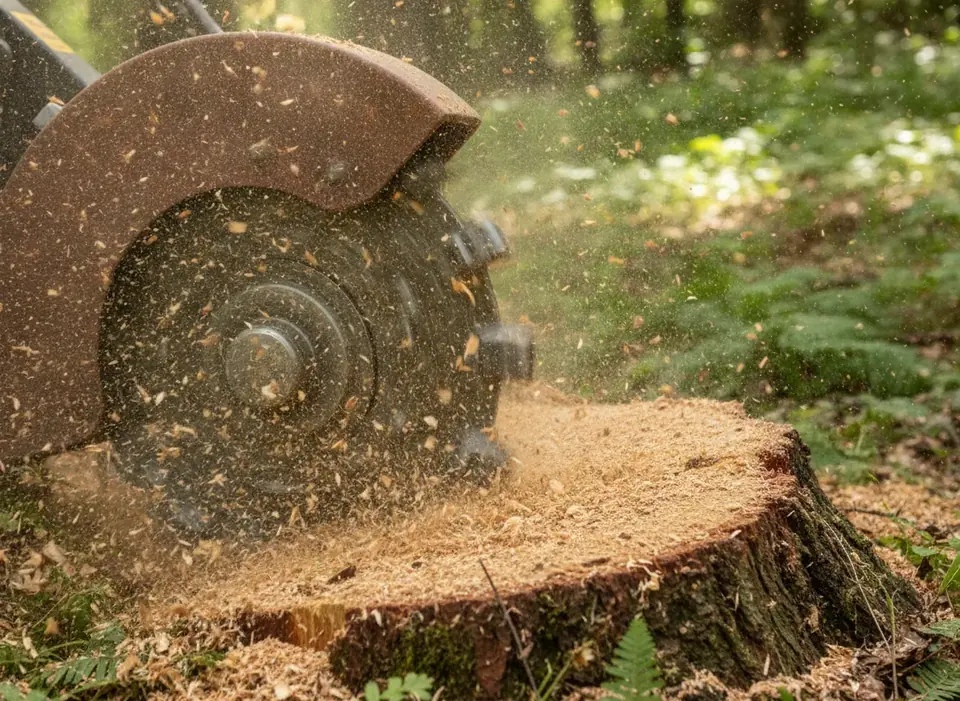
- Grinding removes the visible stump in one visit, typically 6–12 inches below grade. Most of the wood near the surface becomes chips. Buried roots remain and keep decaying. See stump grinding vs. removal.
- Full extraction digs out the stump and main roots, leaving less buried wood but a bigger hole and a higher bill. See stump removal.
- Leaving it means years of a slowly rotting food source in the yard. Not a disaster, but not ideal next to the house.
What to do with the grindings
Grinding produces a pile of wood chips mixed with soil, often more volume than the stump itself. Your choices:
- Use them as mulch out in the yard. Aged chips are the safer choice, and keep them away from the house, not piled against the foundation or siding.
- Use them as fill in the grinding hole, expecting the fill to settle as chips decompose (top it up after a few months).
- Have them hauled away and the hole filled with topsoil, which is the usual route if you're planting grass. Chips mixed into the soil can tie up nitrogen.
Our cleanup, backfill and chip removal page explains what to ask for. According to the City's guidance, Durham doesn't take stumps or grindings at the curb (confirm with Durham One Call at 919-560-1200), and burning them is unlawful inside city limits.
Typical costs
Typical ranges from published cost guides (2025–2026) — estimates, not quotes:
| Item | Typical range |
|---|---|
| One average stump, Durham area | about $150–$450 (Durham average about $327) |
| Full stump removal (excavation) | about $175–$520 |
| Chip haul-away | $2–$3 per inch, or about $80–$125 |
| Topsoil backfill per hole | about $50–$100; seed or sod $75–$200 |
The Durham stump grinding cost guide has the full table and a calculator. In Morrisville, where new-build lots often have leftover stumps, see stump grinding in Morrisville.
Before you hire
- Ask for a certificate of liability insurance, and check workers' comp (three or more employees) with the NC Industrial Commission's coverage search.
- Get a written quote with grinding depth, surface roots, chip haul-away and backfill spelled out.
- Ask who requests the NC 811 locate, and mark your private irrigation, invisible fence and lighting lines.
- If the company offers to treat the stump with herbicide to stop sprouts, ask for its NC commercial pesticide applicator license number.
Frequently asked questions
Will termites in my stump spread to my house?
Not necessarily. NC State Extension says swarmers found outdoors near tree stumps or landscape timbers are not an indication that your house is infested. Eastern subterranean termites are common in North Carolina soil anyway. The bigger risk is wood touching the soil at the house. If a stump is close to the foundation, a termite inspection is a sensible step.
Do stump grindings attract termites?
Grindings are wood, and eastern subterranean termites feed on almost anything that contains cellulose. Used as mulch out in the yard, aged chips are low-risk. Keep them away from the foundation and siding rather than piled against the house, and don't let any wood mulch bridge soil to the structure. Ask the grinder to haul chips away if you prefer.
Should I grind a stump to prevent termites?
Grinding removes the visible stump and most of the wood near the surface, which takes away an easy food source, but it does not remove every root or protect your house on its own. If termites are a concern, especially for a stump close to the foundation, combine grinding with a termite inspection from a pest control company.
Get the stump out of the way
A free quote request takes about a minute. Independent local stump grinding companies can quote grinding, haul-away and backfill, and you decide whether to go ahead.